Table of Contents
Choosing a Full IELTS Mock Test is one of the most useful ways to discover whether your preparation is working under realistic pressure. Individual exercises can improve specific skills, but they do not show how concentration, timing, fatigue, and decision-making interact across an entire test. A complete simulation gives you a clearer picture of what you can currently do while the clock is running.
This guide explains what to expect in an IELTS mock test, from choosing the correct version to completing Listening, Reading, Writing, and Speaking. It also shows how the experience differs from casual practice and how to use the result as a diagnostic tool rather than treating it as a guaranteed prediction of your official score.
Before booking a Full IELTS Mock Test, confirm whether you require an Academic IELTS mock test or a General Training IELTS mock test. The Listening and Speaking formats are shared, but the Reading and Writing sections differ. You can review the IELTS Academic and IELTS General Training pathways before selecting the correct version.
Full IELTS Mock Test: What Is It Designed to Simulate?
A Full IELTS Mock Test is a structured, timed simulation of the real examination process. It should reproduce the order, task types, time limits, and working conditions closely enough to reveal how you perform when you cannot pause the test, check a dictionary, or extend the session. Its main purposes are familiarisation, diagnosis, and targeted improvement.
A reliable IELTS mock test format should assess all four skills rather than presenting a short collection of unrelated questions. It should also use materials that match the version you intend to take. The official IELTS test format includes Listening, Reading, Writing, and Speaking, while Academic and General Training use different Reading and Writing content.
More Than a Full-Length IELTS Practice Test
A full-length IELTS practice test becomes more valuable when it produces information you can act on. A score alone may show that a weakness exists, but useful feedback should help you understand why it happened. For example, a low Reading result could reflect slow passage navigation, misunderstood question types, careless spelling, or ineffective time allocation.
An effective Full IELTS Mock Test can help you evaluate:
- Your ability to remain focused through several consecutive sections.
- Whether your IELTS mock test timing strategy is realistic.
- Which question types repeatedly reduce your accuracy.
- Whether your Writing responses address every part of the task.
- How naturally and clearly you respond during a Speaking interview.
The result is still indicative rather than an official IELTS certificate. Treat it as evidence for planning your next study steps, not as a promise that the same band score will appear on test day.
What Happens Before the Mock Test Begins?
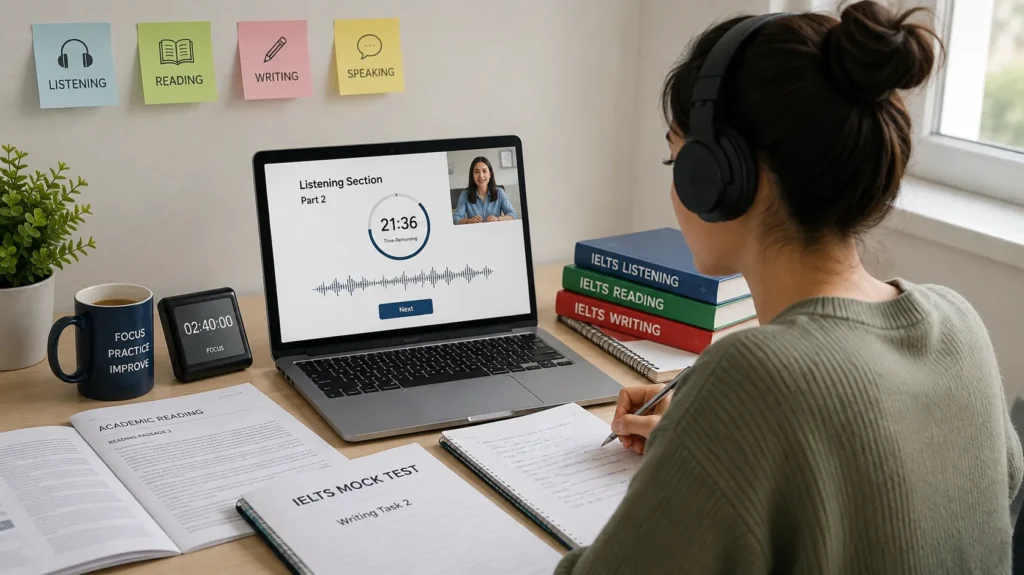
Preparation starts before the first recording plays. When booking an online IELTS mock test, choose the correct test version, confirm the start time in your local time zone, and read the instructions carefully. You should know which sections are included, how the Speaking appointment works, when the test will submit, and when feedback is expected.
Use a quiet room, a stable internet connection, reliable headphones, and a computer that you have already tested. Close unnecessary tabs and applications, silence notifications, and keep only permitted materials nearby. These details may appear minor, but technical interruptions and an unfamiliar setup can make the result less representative of your actual ability.
Choose Academic or General Training Carefully
Do not select a version because it appears easier. Choose according to the test required by your university, employer, professional body, or immigration route. If you are still uncertain, compare the two test types before booking and use the official IELTS sample test questions to inspect the different Reading and Writing tasks.
For additional preparation before the simulation, use the IELTS practice tests library to learn common question formats. However, avoid repeating the same materials immediately before your Full IELTS Mock Test. Familiar questions can inflate your result and reduce the diagnostic value of the session.
IELTS Mock Test Sections and Timing
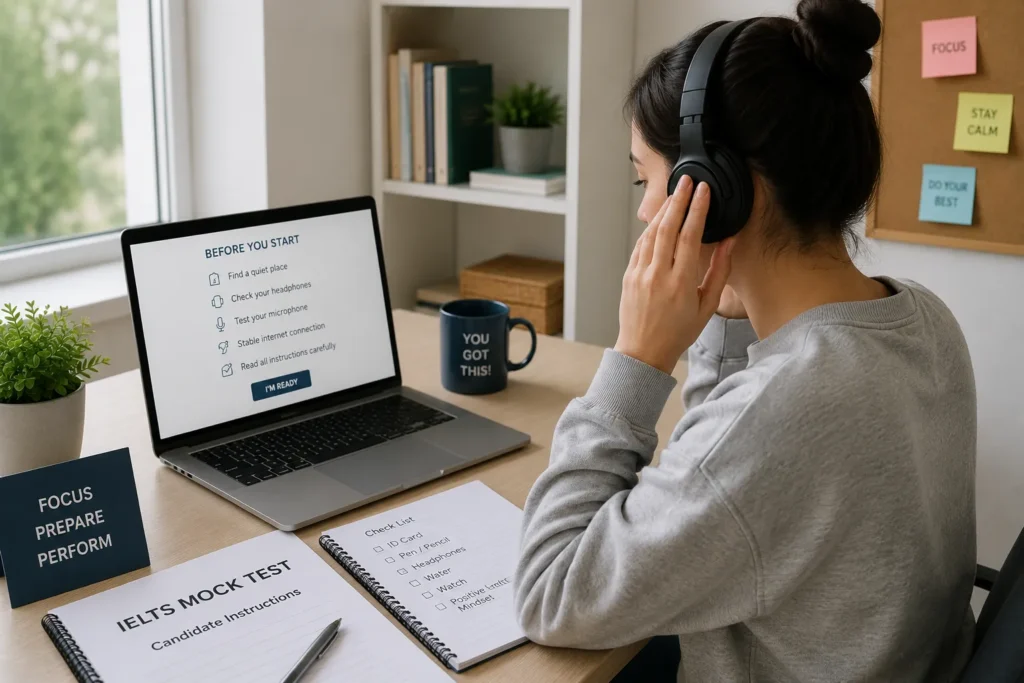
The IELTS mock test sections should reflect the four skills used in the official examination. According to the official IELTS Academic format, Listening lasts approximately 30 minutes, Reading lasts 60 minutes, Writing lasts 60 minutes, and Speaking lasts 11–14 minutes. Mock providers may include additional administrative time, so always follow the instructions supplied for your specific session.
Listening
Listening contains four parts with 40 questions in total. During a Full IELTS Mock Test, expect the audio to continue without convenient pauses for reviewing difficult answers. The section tests more than comprehension: you must preview questions quickly, follow the recording, observe word limits, and enter answers accurately.
Reading
Reading gives you 60 minutes to answer 40 questions. Academic and General Training use different source materials, but both demand disciplined pacing. A realistic mock helps you decide when to continue searching, when to make the best-supported choice, and how much time to reserve for checking your answers.
Writing
Writing lasts 60 minutes and contains two tasks. Task 2 carries more weight, so a practical time plan is essential. The Full IELTS Mock Test should reveal whether you can analyse the prompt, organise ideas, develop supporting points, and leave enough time to review grammar and wording.
Speaking
Speaking is a structured interview with three parts. Use the simulation as IELTS test day practice: answer naturally, extend ideas where appropriate, and avoid memorised speeches. The goal is to demonstrate communicative ability while becoming comfortable with the pace and pressure of a live interview.
How long does a Full IELTS Mock Test take?
A Full IELTS Mock Test usually requires about three hours for Listening, Reading, and Writing, with additional time for the Speaking section. In the official IELTS test, Listening, Reading, and Writing are completed in one session without breaks and take approximately 2 hours and 40 minutes. Speaking lasts 11–14 minutes, although a mock provider may schedule it separately.
What sections are included in a Full IELTS Mock Test?
A properly structured Full IELTS Mock Test should include Listening, Reading, Writing, and Speaking. Listening and Speaking are the same for Academic and General Training candidates, while Reading and Writing differ. Candidates should therefore select the mock test version that matches the examination required by their university, employer, professional organisation, or immigration pathway.
Is an IELTS mock test score the same as an official IELTS result?
No. An IELTS mock test score is an estimate intended to identify your current strengths and weaknesses. Only an authorised official test produces a recognised IELTS result. A well-designed mock may use the IELTS nine-band scale and official assessment criteria, but the result should be treated as diagnostic guidance rather than a guaranteed test-day score.
Will I receive feedback after a Full IELTS Mock Test?
Feedback depends on the provider. A useful Full IELTS Mock Test should explain more than the final band estimate. Listening and Reading feedback may identify incorrect answers and problem question types, while Writing and Speaking feedback should refer to relevant assessment criteria. Official IELTS resources publish scoring guidance and band descriptors that help explain how productive skills are evaluated.
What happens during an IELTS Speaking mock test?
An IELTS Speaking mock test should simulate a three-part interview. Part 1 covers familiar personal topics, Part 2 requires an extended response to a topic, and Part 3 develops a broader discussion. The official Speaking test lasts 11–14 minutes and assesses fluency and coherence, lexical resource, grammatical range and accuracy, and pronunciation.
Should I prepare before taking a Full IELTS Mock Test?
Yes, but avoid memorising answers or practising the exact mock materials in advance. First learn the test format, basic instructions, and common question types. Official IELTS sample questions can help you understand what each section requires. The mock should then measure how effectively you apply your skills under timed conditions rather than how well you remember previously seen answers.
How often should I take a full-length IELTS practice test?
Take a full-length test when you need a realistic progress check, not every day. After each attempt, analyse mistakes and complete focused practice before repeating the experience. Taking tests too frequently without correcting underlying weaknesses may produce similar results. A practical schedule depends on your preparation period, target score, and the amount of time needed to apply the feedback.
Can I take a Full IELTS Mock Test online?
Yes. An online simulation can be effective when it includes realistic timing, suitable question formats, clear submission rules, and properly assessed Writing and Speaking. Before starting, test your internet connection, headphones, microphone, and computer. You can review the available Full IELTS Mock Test service and confirm whether Speaking is held during the same session or booked separately.
Full IELTS Mock Test vs Short Practice Exercises
A Full IELTS Mock Test and a set of practice exercises serve different purposes. Short drills are useful for learning one question type, reviewing vocabulary, or correcting a specific weakness. A complete simulation tests whether you can apply those skills continuously while managing time, attention, and fatigue.
Timed Simulation Versus Skill Practice
Untimed practice allows you to stop, check a rule, replay an explanation, and study mistakes immediately. A realistic mock removes those supports. Listening, Reading, and Writing should be completed under firm time limits, while Speaking should follow a structured interview. This creates a more honest picture of your current test readiness.
A Diagnostic Report Versus a Single Score
The most useful difference is the quality of the information you receive afterwards. A percentage or estimated band can show where you stand, but detailed feedback explains what to improve. Writing comments may identify weak task coverage, organisation, vocabulary, or grammar. Speaking feedback may reveal hesitation, limited development, pronunciation problems, or repetitive language.
Best Practices for Taking a Full IELTS Mock Test
Before the Test
Choose a day when you can protect the full testing period from interruptions. Prepare your computer, headphones, microphone, internet connection, water, and permitted stationery in advance. Use the same screen setup and input method you expect to use on test day whenever possible.
Do not study the exact questions beforehand. Familiar content can produce an artificially strong result. Instead, review the test format through the practice tests library, then use unfamiliar material for your formal simulation.
During the Test
Follow the timer even when a section goes badly. Do not pause to search for vocabulary, check grammar, or ask someone for help. Mark uncertain answers when the system allows it, make the best evidence-based decision, and continue. The purpose of a Full IELTS Mock Test is to observe your real decision-making under pressure.
After the Test
Review patterns rather than isolated errors. Separate knowledge problems from strategy problems. For example, a wrong Reading answer may come from misunderstood vocabulary, poor passage navigation, or rushing. A weak essay may reflect language limitations, incomplete planning, or failure to address every part of the prompt.
If Writing is your main concern, targeted IELTS Writing correction can help you turn general feedback into specific revisions.

Common IELTS Mock Test Mistakes
The first mistake is turning a simulation into open-book practice. Pausing the clock, replaying audio, using translation tools, or extending Writing time makes the final result less useful. Those activities belong in study sessions, not in a diagnostic mock.
The second mistake is focusing only on the overall estimated band. Two candidates with the same overall result may need completely different plans. One may need stronger Writing task response, while another may need faster Reading decisions or more developed Speaking answers.
The third mistake is taking repeated full tests without repairing the weaknesses found in the previous one. A better cycle is test, analyse, practise, receive feedback, and retest. You can use IELTS preparation resources between simulations rather than measuring the same unresolved problems every few days.
Finally, do not treat a strong mock result as a guarantee or a disappointing result as a final judgement. Performance can change with task difficulty, health, stress, environment, and preparation quality. Use the evidence to improve your plan.
How Much Does a Full IELTS Mock Test Cost?
At IELTS Clinic, both the Academic and General Training Full IELTS Mock Tests are currently priced at $96. The mock test includes Listening, Reading, Writing, and Speaking and is designed to provide a realistic assessment of your current IELTS performance.
Before booking, review the current test inclusions, Speaking arrangements, feedback process, and result timeline on the IELTS Mock Test booking page.
The mock-test fee is separate from the official IELTS registration fee. Official IELTS test fees vary by location and test provider, so check the current fee through the official IELTS test-centre directory.
Conclusion: Turn Your Mock Result into a Study Plan
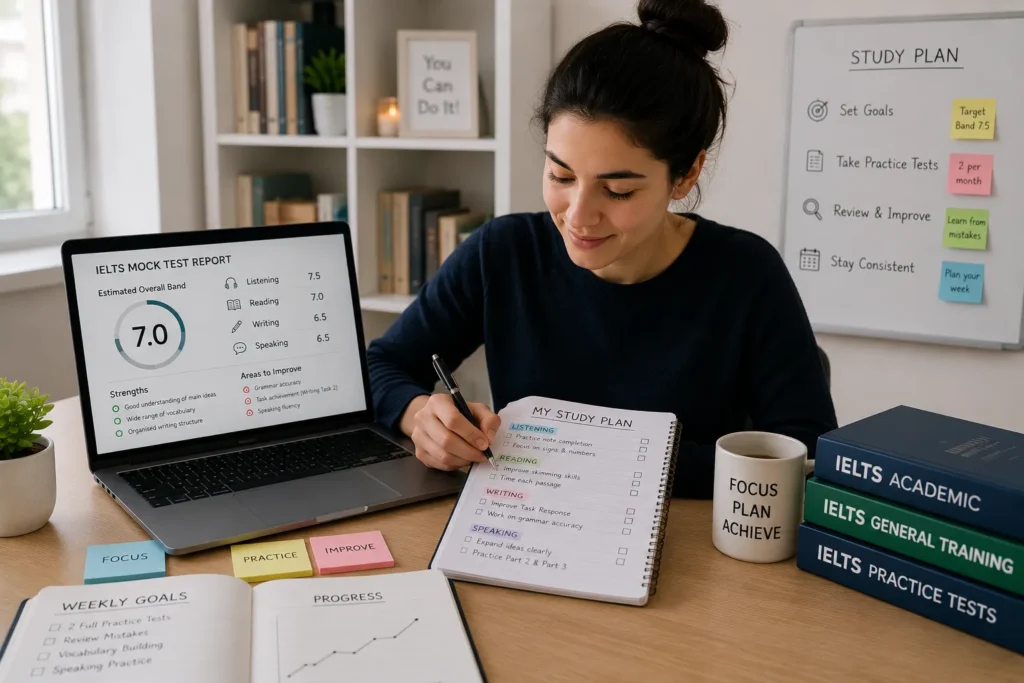
A Full IELTS Mock Test is most valuable when it changes what you do next. Use it to confirm your test version, practise the complete sequence, identify timing problems, and understand which language skills need focused work. Then convert the results into a short list of measurable priorities.
For example, your next plan might include timed Reading sets, weekly essays, recorded Speaking answers, or focused Listening review. Retake a full simulation after you have had enough time to apply the feedback. This makes the second result a meaningful progress check rather than another attempt at the same weaknesses.
When you are ready to experience the complete process, book a Full IELTS Mock Test. Candidates who need guided preparation can also compare IELTS group classes and IELTS private classes to choose a study format that matches their goals, schedule, and feedback needs.